Not a member yet? Sign Up!
Info
Please use real email address to activate your registration





“Since Reading has the largest and one of the most successful Food Science Departments in the UK, it is appropriate for this University to recognise the contribution this Berkshire resident has made to the promotion of Food Science and Chemistry.
Mr. Vice-Chancellor, I present Mr. Heston Blumenthal for the Honorary Degree of Doctor of Science of this University.”
(Prof. Don Mottram, Reading University, 7 July 2006)
-------------------------------------

The Honorary Degree of Doctor of Science is only one in the strings of awards received by Chef Heston Blumenthal, the culinary alchemist famous for his exceptional style of cuisine.
The Fat Duck, a restaurant he opened in 1995, has been voted as one of the best restaurants in the UK and the world. It received 1 Michelin Star in 1998 and 3 Michelin Stars in 2004. Heston’s cookbooks and TV shows have garnered numerous accolades.
Selvia Novita, our good friend who was invited for dinner at the Fat Duck last month, emailed us her impressions and some photos.


The Fat Duck, 45 km west of London is located in scenic Bray village in Berkshire county. The village boasts a wealth of cottages and houses, fine dining and attractive riverbank properties.
Whereas it took many patrons weeks to get a table there, Selvia said her group of 6 was lucky because after making a phone reservation they only had to wait for two weeks for a Saturday evening dinner at the restaurant.
Life-changing cuisines
The Fat Duck offers 14 courses of tasting menu where guests spend approximately 4 hours to savor the dishes.


Menu no. 3 is chicken liver parfait, oak moss and truffle toast. Heston explained to Caroline Hire the food editor of BBC Good Food that it was inspired by Alain Chapel’s jelly of pigeon and star anise, one that Heston considers his life-changing gastronomic meals.
Alain Chapel was a French master chef and restaurateur who in the 70s was in the forefront of French gastronomy and received an unheard of rating of three Michelin stars in 1973.

Of the entire menu, Selvia loved menu no. 5 the most, the roast foie gras with barberry, braised kombu (seaweed) and crab biscuit. She said it was the best foie gras she ever had, very clean, and no smell or after taste.
The Fat Duck, Selvia noted, has an old British interior with homey ambience. There was no background music like in most restaurants; hence you can really have a good conversation with friends.
The indoor lighting was set in a moderate illumination. It was not too bright and not dimmed either. Although there is no dress code, guests still dress up pretty neat.
A story for every dish
Servers explained each course in a very precise way, especially the ingredients and how they prepare the dish as well as the story behind it.
The story for menu no. 6, mad hatter’s tea party (c.1850), for example, is Alice’s Adventures in Wonderland where Alice becomes a guest at a "mad" tea party along with the March Hare, the Hatter and Dormouse.

Jasper Gerard wrote for The Telegraph when the dish was just launched in 2009 about a "tea bag" on a string, served in china cup and resembling a Mad Hatters' pocket watch that was actually dried consommé covered in gold leaf. Once hot water is poured onto it from a teapot, it dissolves into a clear soup. A bowl with various ingredients were arranged into a scene from Alice in Wonderland.
Sensory science
A sub-discipline in food science is sensory science, the study of the reactions of the five senses—sight, hearing, smell, taste and touch—and their reaction to the characteristics of physical matter.

Menu no. 7, the sound of the sea, is a multisensory meal where guests listen to an iPod while consuming the food and feel like they are on the beach.
Those who have the courage to prepare sound of the sea at home could see how elaborate it is. StarChefs.com has adapted Heston Blumenthal ‘s recipe here.
Scientific authors, Heston Blumenthal among them, of an article published in Food Quality and Preference by Elsevier described their experience of flavor involving integration of multiple sensory inputs. The appearance of food, according to the authors, generates expectations about food flavor, and past work suggests that these expectations if confirmed enhance the flavor experience.
Sweet shop
The sweet taste for the evening, began with menu no. 10, the hot and iced tea. Menu no. 12, the BFG or the black forest gateau looked like one chocolate block covered with chocolate dusts but inside there were actually nine layers of assorted cakes.

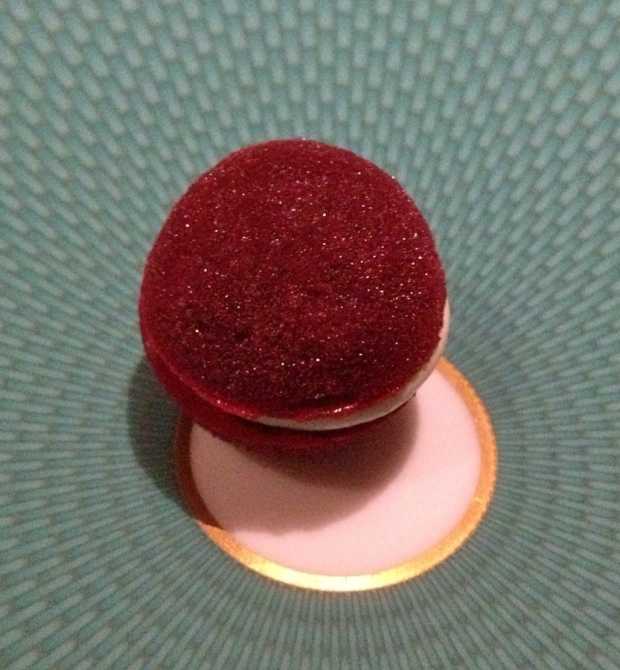
The evening finale, menu no. 14, like a kid in a sweet shop, was really a treat. A selection of sweets consisting of aerated chocolate, coconut baccy - coconut infused with an aroma of black Cavendish tobacco, and apple pie caramel amused guests immensely. The most impressive one was the queen of hearts she made some tarts. It was a bar of white chocolate playing card that envelopes red jam.


Selvia wrote: “ Dinner at the Fat Duck was indeed a multisensory experience. The service was wonderful, the servers were polite but they had jokes from time to time. All the dishes were amazing, It was a fun evening and I definitely agree that the Fat Duck is one of the best restaurants in the world.”
--------------------------------------
“When you meet Heston what is so striking is his love of his subject – food and the underlying science. He seeks an understanding about the way the human responds to sensory stimuli; why certain flavours complement each other; why meat texture changes with cooking temperature; why the size of ice crystals in ice-cream affect its texture; and how food processing can be used to develop new sensory experiences. He is continually seeking new ways of introducing science into his cuisine.” (Prof. Don Mottram, Reading University, 7 July 2006)
Images: Featureflash, Kevin Day/Shutterstock, Geograph, Selvia Novita



 Omar Niode Foundation Blog is licensed under a Creative Commons Attribution-NonCommercial-ShareAlike 3.0 Unported License.
 Close
Close