Not a member yet? Sign Up!
Info
Please use real email address to activate your registration




In capitals of the world, certain coffee houses are popular spots where for the price of a cup of coffee people could catch up on news and gossip or test the waters for political decisions.
Democracy in a coffee shop
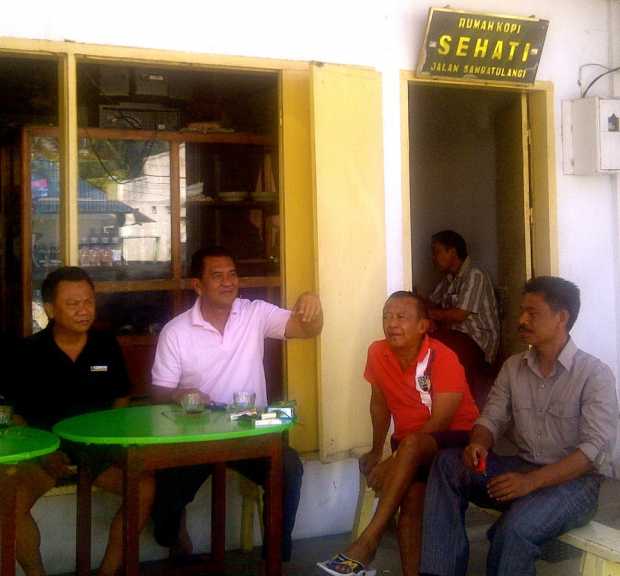
In Gorontalo, a provincial capital, on the island of Sulawesi, Indonesia, a coffee house called Sehati is such a place. Kompas, the largest daily newspaper in Indonesia placed an article: A Space of Democracy in a Coffee Shop, outlining what is happening at Sehati.
Sehati, opened as a small business in 1980, is where people from all walks of life meet to channel their views and aspirations about politics and current affairs in Gorontalo. Here a governor discusses his policies in front of street vendors, activists, pensioners, business people and active civil servants. Most often popular topics brought by important resource persons are broadcasted by a local radio, through an interactive program, questions and answers sessions with listeners all over Gorontalo.
.jpg) Do not expect Sehati to look like a cozy outlet of international coffee shop chain. Sehati is a very modest watering hole with wooden chairs and coffee served in cheap clear cups.
Do not expect Sehati to look like a cozy outlet of international coffee shop chain. Sehati is a very modest watering hole with wooden chairs and coffee served in cheap clear cups.
Although there is no air condition in Sehati, the temperature that ranges from 22 - 32 degrees Celsius with humidity 60 - 97 % in Gorontalo do not stop people from visiting the place that starts buzzing at 6.00 AM. Market munchies readily available for those who would like to have light breakfasts.
Pinogu coffee
Gorontalo ranked thirtieth amongst Indonesia’s 33 provinces in terms of provincial Gross Domestic Product. Last year it has a poverty level of 18.75% compared to the national average of 12.36%. Coffee production in the area as recorded by the regional investment board is almost 1000 tons a year.
Sehati, the coffee house, serves Pinogu coffee, a local coffee harvested from Pinogu village in Gorontalo. Reaching Pinogu is a challenge as there is no asphalt road leading to the area. Locals walk for 6 hours through the woods, crossing creeks and rivers, up and down the hillside. A motorcycle rides to Pinogu costs as much as a one-way cheap airline ticket from San Francisco to Los Angeles.
Pinogu coffee, like most crops planted in the fertile village is organically grown and sells for Rp. 15.000 (US$ 1.50) per kilogram. Kompas.com wrote that it costs Rp. 5000 (US$ 0.50) to haul a kilogram of goods from Pinogu.
A cup of black coffee in Sehati is priced at Rp. 3000 (US$ 0.30); with milk it’s Rp. 4000 (US$ 0.40) compared to at least US$ 4.00 a cup in international coffee shop chain.
Coffee- chewed & infused
1.jpg) Coffee, according to The Economist, originated in the highlands of Ethiopia, where its beans were originally chewed rather than infused for their invigorating effects. It spread into the Islamic world during the 15th century, where it was embraced as an alternative to alcohol due to its sobering and stimulating senses. Coffee entered Western Europe during the 17th century, at first as a medicine, and then as a social drink in the Arab tradition. Indonesia was the first place, outside of Arabia and Ethiopia, where coffee was widely cultivated and first exported in 1711.
Coffee, according to The Economist, originated in the highlands of Ethiopia, where its beans were originally chewed rather than infused for their invigorating effects. It spread into the Islamic world during the 15th century, where it was embraced as an alternative to alcohol due to its sobering and stimulating senses. Coffee entered Western Europe during the 17th century, at first as a medicine, and then as a social drink in the Arab tradition. Indonesia was the first place, outside of Arabia and Ethiopia, where coffee was widely cultivated and first exported in 1711.
The US National Coffee Association states that there are many methods for brewing a fine cup of coffee, based on customers’ needs and preferences. In manual brewing, the Association’s advise is to let the water come to a full boil, turn off the heat source and allow the water to rest a minute before pouring it over the grounds.
Sehati’s method is not to have its coffee brewed; rather to mix the coffee and water in a pan and cook until it reaches a boiling point. Coffee is then served after separating the coffee grounds with a metal screener.
By 10.00 AM Sehati still has coffee available, but the market munchies are mostly gone. These are the local favorites such as banana fritter, pancake with palm sugar, sticky glutinous rice, sweet omelet, sponge cake, pasty and bowsprit cake. The munchies sell for Rp. 1000 (US$ 0.10) to Rp. 2000 (US$ 0.20) a piece. .jpg)
According to Sehati owner, Sutrisno Rahim Poiyo, on weekdays Sehati sells 200 cups on average. By weekends, especially when there is a broadcasted event and the place is packed, Sehati earned millions of rupiah, possibly by selling 1000 cups of coffee.
History noted that the first coffee house opened in Damascus in 1530 (smithsonian.com) while in England, a coffee house began in Oxford in 1652. The Economist acknowledged coffeehouses as providing a forum for education, debate and self-improvement. They were nicknamed “penny universities” in a contemporary English.
Sehati is certainly a penny university.
-----------
Photos by Mochtar Niode.
Click here to Discover Gorontalo.



 Omar Niode Foundation Blog is licensed under a Creative Commons Attribution-NonCommercial-ShareAlike 3.0 Unported License.
 Close
Close